The short answer first: Ramayana: The Legend of Prince Rama, the beautiful anime film made by Japanese director Yugo Sako, never got a theatre release in India when it was made in 1992-93.
It was not released in Indian cinemas for one reason alone. It was stopped by three things coming together at the same time: the Indian government refused to support it as a coproduction, a Hindu group protested against gods being shown as cartoon figures, and India was going through the worst communal tension of that time, after the Babri Masjid demolition on 6 December 1992.
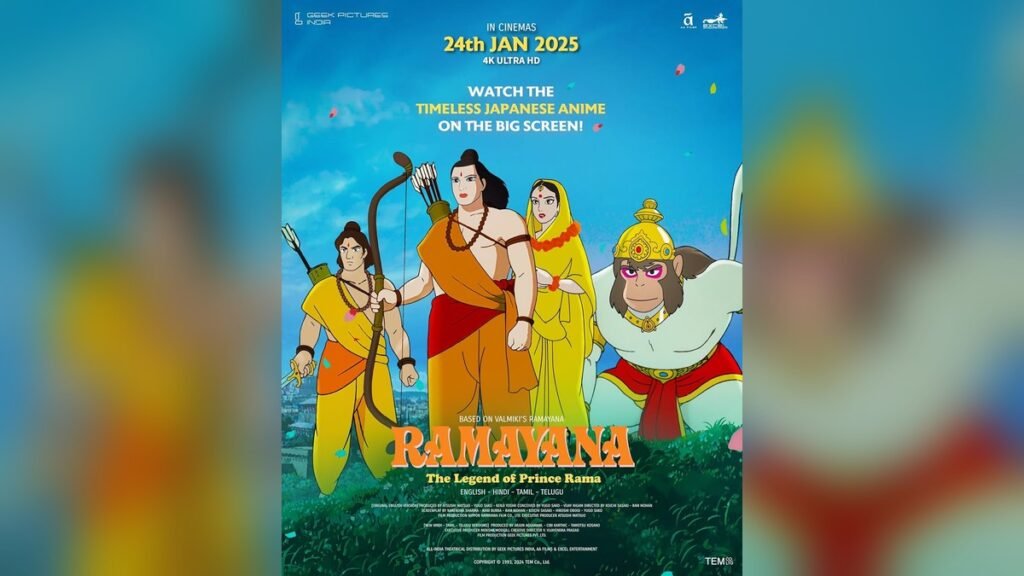
The film was not lost, though. It came to Indian TV in 1995, played for years on Cartoon Network, and finally got its first proper Indian theatre release in 4K only on 24 January 2025 — more than 30 years after it was made.
This blog tells that full story in simple words: who made it, why it was stopped, what happened after, and where you can watch it now.
What Is This Film? Ramayana: The Legend Of Prince Rama, In Simple Words
Ramayana: The Legend of Prince Rama is an anime film based on Valmiki’s Ramayana. It tells the story of Prince Rama, from his childhood in Ayodhya to his exile, Sita’s kidnapping by Ravana, and the war in Lanka.
It was made in Japan, with Indian help. It is not a short cartoon for small children. It is a full 135minute film, with serious music by Vanraj Bhatia, songs in Sanskrit, and fight scenes that were praised even outside India.
The film was made to mark 40 years of India-Japan friendship. That is why it was supposed to be a joint project between the two countries. In the end, it was mostly made in Japan, with Indian artists and advisors helping from there.
If you grew up in the 1990s or 2000s in India, you may have already seen it without knowing its story. It played many times on Cartoon Network in India, and later on Doordarshan, in Hindi and English. Many people in India remember it as “the cartoon Ramayana” — but few people know why it never came to theatres in the first place.
Who Was Yugo Sako? A Japanese Man Who Fell In Love With Ramayana
Yugo Sako was a Japanese documentary filmmaker. He was not Indian, and he was not born in a Hindu family. He was raised in a Buddhist temple after losing his parents early in life.
In 1983, Sako came to India to make a documentary called The Ramayana Relics. The film was about the excavations of archaeologist Dr B. B. Lal, near Allahabad. While working on that documentary, Sako read the Ramayana — not once, but in 10 different Japanese translations.
He fell in love with the story. He felt that a live-action film, with real actors, could not do justice to Ram, because Ram is God. In his own words, which he said in an interview: “Because Ram is God, I felt it was best to depict him in animation, rather than by an actor.”
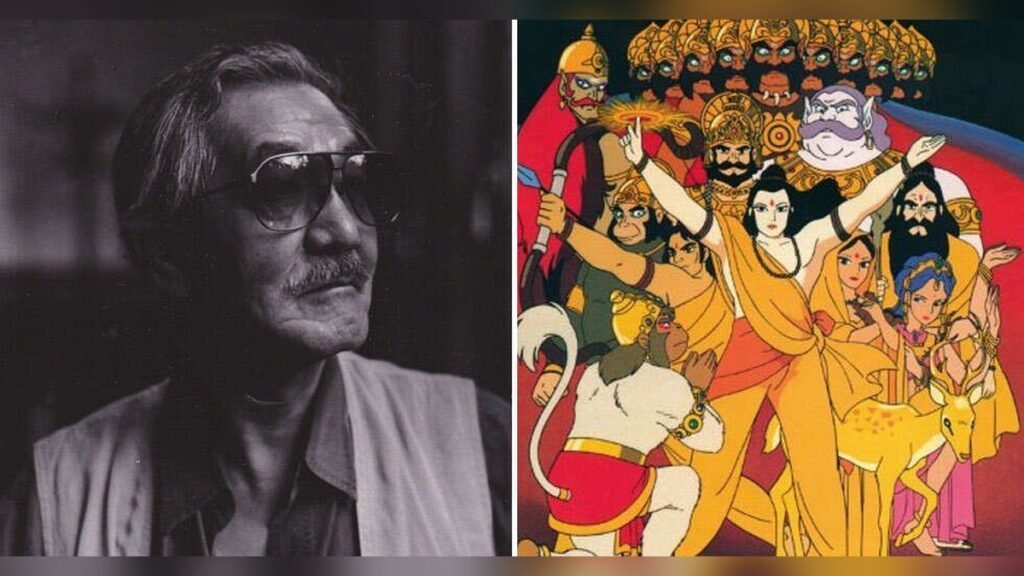
So he decided to make Ramayana as an anime film. In Japan, animation is not only for children. It is a serious art form that tells serious stories for adults too. Sako wanted to use that art form for Ramayana.
He did not work alone. He worked with Ram Mohan, who is called the father of Indian animation, and with Japanese director Koichi Sasaki. Sako was the man behind the idea and the producer. Sasaki and Ram Mohan directed the film together.
About 450 artists worked on it, from both India and Japan. They drew nearly 1,00,000 hand-drawn pictures, called cells, to make the film move. It took almost 10 years to finish, from the mid-1980s to 1992-93.
The Full Timeline: How The Film Was Stopped, Step By Step
| Year | What happened |
| 1983 | Yugo Sako comes to India for the documentary The Ramayana Relics. He reads 10 versions of Ramayana and decides to make it as an anime film. |
| Mid- 1980s | Work starts on the anime Ramayana. Sako wants it as an India-Japan coproduction, so Indian artists can keep it authentic. |
| Late 1980s | The Indian government refuses the co-production. Ram Mohan later said the government told them: “Ramayana is a very sensitive subject and cannot be depicted as a cartoon character.” |
| Early 1990s | A misunderstanding starts. An Indian newspaper report about Sako’s documentary is read the wrong way, and a protest letter is sent to the Japanese Embassy in Delhi. The letter, from the Vishwa Hindu Parishad (VHP), says no foreigner can make Ramayana into a film, because it is India’s great heritage. |
| 1992 | The film is completed. In the same year, the Ram Janmabhoomi movement reaches its peak, and the Babri Masjid is demolished on 6 December 1992. Riots break out in Bombay, Calcutta, and other cities. A Ramayana film, made as a cartoon, is seen as too risky to release in theatres at that time. |
| 1993 | The film is shown at the 24th International Film Festival of India, and at film festivals abroad. But it does not get a normal theatre release in India. |
| 1995 | Three years after it was made, the film is finally shown on Indian television, on Doordarshan. Later, a Hindi dubbed version comes, and it plays regularly on Cartoon Network. |
| 2000- 2001 | The film releases in America, with a new English dub, under the name The Prince of Light: The Legend of Ramayana. James Earl Jones narrates it. A young Bryan Cranston, who later became famous for Breaking Bad, voices Rama in that dub. |
| 2012 | Yugo Sako dies, while writing a film about Lord Krishna. That film, called Lord Krishna — The Celestial Cowherd, never gets made. |
| 2022 | Prime Minister Narendra Modi mentions the anime Ramayana in his Mann Ki Baat radio programme, which brings the film back into public memory. |
| 24 Jan 2025 | The film finally releases in Indian theatres for the first time, in a 4K remaster, in Hindi, Tamil, Telugu, and English. |
Why Was It Banned? The Three Reasons, Explained Simply
People use the word “banned” for this film, but it is important to understand what that word means here. There was no single court order that banned it forever. It was stopped in three different ways, and each one made the next one worse.
- The government said no to a co-production
Sako wanted Indian involvement from the start, because he wanted the clothes, the gestures, the music, and the story to look and feel Indian. Ram Mohan, who went to Tokyo to supervise the work, had to teach the Japanese artists even small things — for example, how a dhoti is worn, because they were drawing it like pyjamas.
But the Indian government did not agree to be a co-producer. According to Ram Mohan, the government said Ramayana was too sensitive a subject to be shown as a cartoon. Sako and Mohan tried to explain that animation in Japan is a serious art form, not only for children. The government did not change its mind.
Because of that, the film had to be finished in Japan, not in India, with Mohan and other Indian consultants travelling there to help.
- The VHP protested against gods as cartoon figures
In India, at that time, many people saw animation only as a children’s genre. The idea of showing Ram, Sita, and Ravana as cartoon figures felt wrong to some groups.
The Vishwa Hindu Parishad (VHP) sent a protest letter to the Japanese Embassy in Delhi. The letter said, in simple words, that Ramayana is India’s great national heritage, and no foreigner should make it into a film on their own.
There was also a misunderstanding at the start. A newspaper report about Sako’s earlier documentary was read as if he was already making a new Ramayana film without permission. After Sako explained his plan — that he wanted to make Ramayana with respect, and with Indian help — some of that misunderstanding was cleared. But the protest had already made the film a controversial subject, and no one in India wanted to take the risk of releasing it in theatres.
Ram Mohan later said the team had to be very careful: “We had to take care that the Indian audience is not offended. We didn’t do anything that was not looking right, like Ram should not have looked like this or Sita should have been like this.”
That is also why the film keeps its story very simple and straight. It does not add new scenes or change Valmiki’s story. It tells the epic in order, from start to finish, so that no one could say the story was changed.
3. The timing was the worst possible timing: 1992
The film was ready in 1992. That was the same year the Babri Masjid was demolished on 6 December 1992, and riots broke out across India.
In that atmosphere, releasing any film about Ram, even a respectful one, in theatres was seen as dangerous. The government and the distributors did not want to take that risk. So the film was kept away from Indian cinemas, even though it was ready.
This is the part that makes the story sad. The film was not stopped because it was bad, or because it insulted Ramayana. It was stopped because the time was wrong. If it had been made 10 years earlier, or 10 years later, its story in India might have been very different.
Was It Really A “Ban”? The Honest Answer
Let us be clear, because many blogs on the internet use the word “banned” without explaining it:
The film was not released in Indian theatres in 1992-93. That is a fact.
It was shown at a film festival in India in 1993, and on Doordarshan in 1995. So it was not hidden from Indians completely.
It played for years on Cartoon Network in India. Many Indians saw it on TV, not in theatres. There is no public record of a formal, permanent ban order that we can point to. What happened was a mix of government refusal, protest, and distributors deciding not to release it in that tense time.
So when you read “Ramayana anime was banned in India,” read it as “it was stopped from a theatre release in India.” That is the honest meaning, and it is also the more interesting story — because a film can be stopped without a single ban order, just by fear and timing.
What Happened After? The Film Found Its Audience Anyway
Even without an Indian theatre release, the film did not disappear.
It went to film festivals in Italy, the UK, and America. It won Best Animation Film of the Year at the Santa Clarita International Film Festival in the USA in 2000. It was shown in America in 2001 as The Prince of Light.
In India, it became a TV favourite. Children who watched it on Cartoon Network in the 1990s and 2000s still remember its songs and its fight scenes today. The music by Vanraj Bhatia, and the Sanskrit songs, are still praised by people who watch it now.
The film also had a strange Hollywood chapter. A Hollywood studio wanted to buy it, but they wanted to change the story — they wanted to remove Rama’s exile, and make Rama and Sita go to the forest for their honeymoon instead. Sako and co-producer Krishna Shah refused. Shah later said: “How could we change Valmiki’s text? Yugo would not agree, nor could I. It was against our sensitivities.” The Hollywood deal fell through, and the film stayed faithful to Valmiki.
In 2025, the story finally came full circle. On 24 January 2025, the film was released in Indian theatres for the first time, in a 4K remaster with better sound, in Hindi, Tamil, Telugu, and English. It was distributed by Geek Pictures India, AA Films, and Excel Entertainment. The creative adaptation for the new version was overseen by V. Vijayendra Prasad, the writer of Baahubali and RRR.
It took 32 years. But the anime Ramayana finally got the theatre release it was denied in 1992.
How Much Did It Cost? A Note On The Numbers
You will see different budget numbers for this film on different websites, and we do not want to give you a wrong one as a fact.
Some reports say it cost $6.7 million.
Scroll.in, in a 2017 article, says it cost nearly $13 million.
The Reddit / Medium post that started this blog says it cost Rs 131 crore, and calls it the highest-budget Indian film ever.
These numbers do not match, because they come from different times, different currencies, and different ways of counting the 10-year production. We are giving you all three here, with their sources, so you can see the difference. What is clear is this: it was a very expensive film for its time, and it took a very long time to make, with 450 artists and nearly 1,00,000 hand-drawn cells.
Do not trust a blog that gives you only one of these numbers and calls it the final truth.
Why This Story Matters Now, In 2026
This story matters now for a simple reason: a new Ramayana has just released in India.
Nitesh Tiwari’s Ramayana: Part One, with Ranbir Kapoor as Rama, Sai Pallavi as Sita, and Yash as Ravana, released on 5 November 2026. It is a live-action film, made on a combined budget of Rs 4,000 crore for both parts, with massive advance booking across India.
Read our prediction for that film here: Ramayana Day 1 Collection Prediction: How Big Can It Open?
And read how advance booking went in Karnataka, where Yash as Ravana carried the Kannada version, here: Ramayana Advance Booking in Karnataka: Bengaluru Is Carrying the Kannada Version
In 1992, India was afraid to show Ram as a cartoon in theatres. In 2026, India is celebrating Ram as a Rs 4,000 crore live-action film in theatres. A lot has changed in 33 years — in technology, in money, and in how India sees its own stories on screen.
But the old anime film still has something the new film does not have: it was made by a Japanese man who loved Ramayana so much that he spent 10 years of his life on it, and who never saw it released in Indian theatres in his lifetime. Yugo Sako died in 2012. He never saw the 4K re-release in 2025. He never saw his Krishna film made.
That is why people call it a tragedy. Not because the film failed — it did not fail. Because the man who made it with so much love did not get to see India welcome it in theatres.
Frequently Asked Questions
Was Ramayana: The Legend of Prince Rama really banned in India?
It never got a theatre release in India in 1992-93, because of government refusal, VHP protest, and the communal tension after the Babri Masjid demolition in December 1992. It was shown on Doordarshan in 1995 and on Cartoon Network later. There is no public record of a formal permanent ban order, so “stopped from theatre release” is the more accurate phrase.
Who directed the anime Ramayana?
It was conceived and produced by Japanese filmmaker Yugo Sako, and directed by Koichi Sasaki and Ram Mohan, the father of Indian animation. Sako got the idea in 1983, while making a documentary about the Ramayana.
Why did Yugo Sako choose animation instead of live action?
Sako said: “Because Ram is God, I felt it was best to depict him in animation, rather than by an actor.” He felt no actor could play Ram properly, and animation could show gods, demons, and flying chariots better than live action at that time.
When did the anime Ramayana finally release in Indian theatres?
On 24 January 2025, in a 4K remaster, in Hindi, Tamil, Telugu, and English. That was more than 30 years after it was made. It was first planned for 18 October 2024, then moved to January 2025.
Where can I watch Ramayana: The Legend of Prince Rama now?
After the January 2025 theatre re-release, check for it on streaming platforms and on YouTube in Hindi and English. It has played on Doordarshan and Cartoon Network in India in the past, and the 4K version was distributed by Geek Pictures India, AA Films, and Excel Entertainment. Availability changes, so check your OTT app for “Ramayana: The Legend of Prince Rama” before you pay for a rental.
What happened to Yugo Sako’s Krishna film?
Sako was writing a film about Lord Krishna, called Lord Krishna — The Celestial Cowherd, when he died in 2012. That film was never made.
Final Words: What Should We Learn From This Story?
The anime Ramayana is not just a film that was banned. It is a reminder of how easily a good film can be lost — not because it is bad, but because the time is wrong, and because people are afraid.
A Japanese man spent 10 years making an Indian epic with love and respect, with Indian artists helping him, and India did not welcome it in theatres for 32 years. When it finally came in 2025, people loved it. That tells you the film was never the problem. The fear around it was the problem.
If you have not watched it yet, watch it. Not because it is old, and not because it was banned, but because it is a beautiful film made by a man who loved Ramayana more than most people who were born with it. Watch it with your family, and tell your children who Yugo Sako was. That is the best way to remember him.
And if you have watched it — on Cartoon Network as a child, or in theatres in 2025 — tell us in the comments: when did you first watch the anime Ramayana, and what do you remember most about it? Your answer will help other readers find this film, which waited 32 years to be seen properly in India.