There’s a particular kind of goosebump that only comes once or twice a decade in cinema — the kind where a story stops feeling like a movie and starts feeling like a ritual you’ve been pulled into. That’s exactly what Japanese audiences are about to experience.
Rishab Shetty’s Kannada phenomenon Kantara (2022) — released in Japan under the title 『カーンターラ 神の降臨』(Kantara: The Descent of God) — finally arrives in Japanese theaters on Friday, June 5, 2026, opening at Shinjuku Piccadilly and cinemas nationwide. Distributor Twin has now unveiled the Japanese original trailer, the striking main poster, fresh scene stills, and a limited Mubi-ticket campaign with an exclusive bonus.
Here’s everything worth knowing before the spirits descend.
A Quick Reality Check: Why This Release Matters
Before the hype, the facts. Kantara wasn’t supposed to be a global juggernaut. Made on a modest budget of roughly 2.8 billion yen (about ₹16 crore) — comparatively tiny for Indian cinema — the film went on to gross around 6.8 billion yen (₹400–450 crore worldwide), roughly 24 times its production cost, and ran in theaters for over 100 days.
It collected over $2.5 million in North America, $3.7 million in the Middle East, and became the first Kannada film ever screened in Vietnam. It won the Silver Peacock Special Jury Award at the 54th International Film Festival of India, and at the 70th National Film Awards, Rishab Shetty took home Best Actor while the film won Best Popular Film.
In other words, Japan isn’t getting a niche curiosity. It’s getting a globally certified blockbuster — three years after the rest of the world fell for it, and right on the heels of the 2025 prequel Kantara: Chapter 1, which expanded the universe and reignited worldwide demand.
The Japanese Trailer: When the Ritual Begins
The newly released Japanese original trailer doesn’t ease you in — it pulls you straight into the heartbeat of the film.
It opens with forest officer Murali (Kishore Kumar G.) uttering the line that sets everything in motion: “The ritual has begun.” What follows is a sensory plunge into village life in harmony with nature — the call-and-response of festival songs, villagers walking the dirt paths toward the Bhoota Kola ceremony, palms pressed together in worship. You can almost smell the incense and coconut oil through the screen.
Then comes the turn. A sharp metallic “sharin” sound slices the air, and the mood fractures.
The trailer pivots into conflict: the Forest Department, in the name of conservation, moves to seize ancestral village land, and Shiva (Rishab Shetty) — the village’s reckless buffalo-racing champion — rises to defend it. The cuts grow tense and unforgiving: villagers warning that “the spirits will not forgive this,” a man collapsing while coughing blood, Shiva tearing through his enemies with the raw force of a charging bull.
And in the final stretch, the golden-faced Panjurli deity appears, letting loose the now-iconic roar:
“Break your promise, and the wrathful god will curse you. Waaaaaaah!”
The trailer closes on a single, electric line of text:
“Is that roar salvation — or destruction?”
It’s a masterclass in restraint and release. The Japanese marketing leans hard into the film’s mystery, its sound design, and its sheer physical energy — exactly the elements that turned Kantara into a word-of-mouth wildfire everywhere it played.
The “Descend” Poster: One Word, Total Impact
If the trailer is the heartbeat, the main poster is the held breath before it.
The centerpiece is the golden-faced Panjurli deity, captured in a moment lifted straight from the Bhoota Kola ritual — radiant, fierce, otherworldly. Above it sits a single, deliberately heavy three-character Japanese copy: 「降りる」(“Descend”).

Beneath the deity, a blurred figure of a man appears to dissolve into the divine form, the two seeming to melt into one another. It’s a visual riddle: where does the human end and the god begin? That ambiguity is the entire thesis of the film — faith, possession, promises, and consequence — compressed into one image.
It’s the rare poster that doesn’t explain anything and yet tells you everything. The only way to resolve the question it poses is to buy a ticket.
Scene Stills and the Mystical Atmosphere
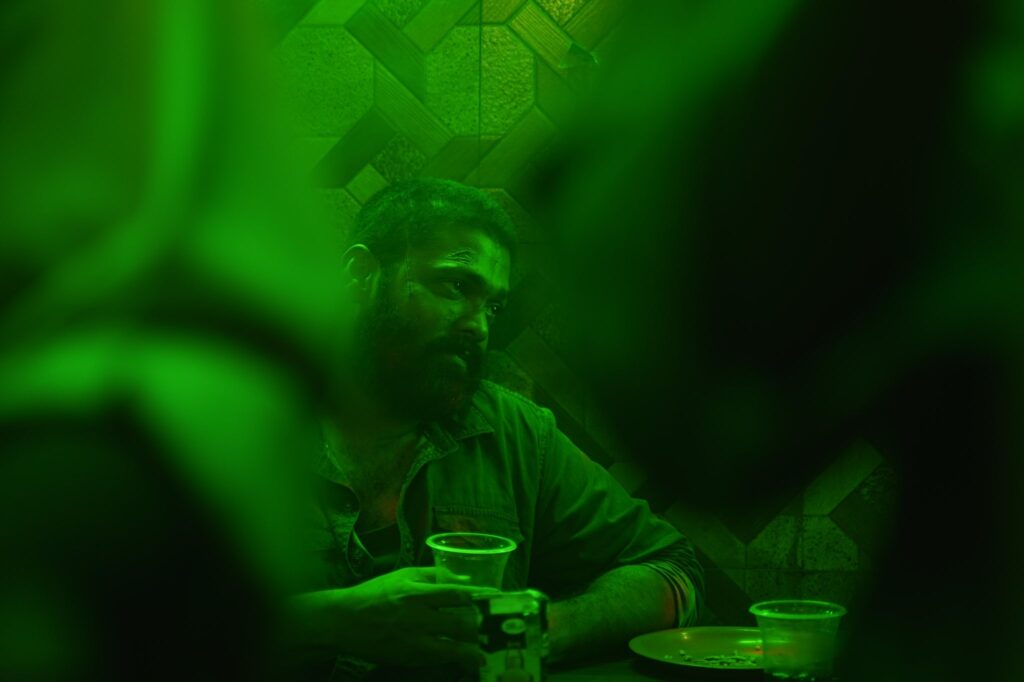
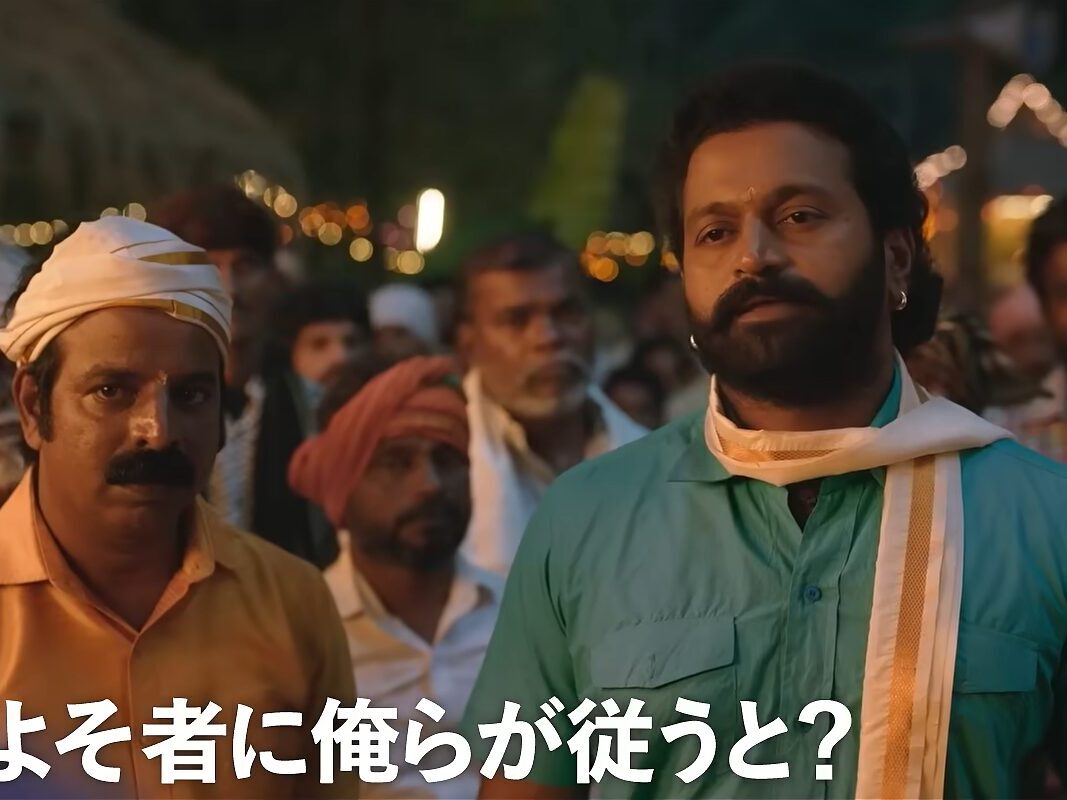
Alongside the trailer and poster, Twin has released a set of scene stills that double down on the film’s atmosphere. Expect lush coastal Karnataka forests, the textured detail of the ritual costumes and the towering headdress, and stolen frames of high-tension drama.
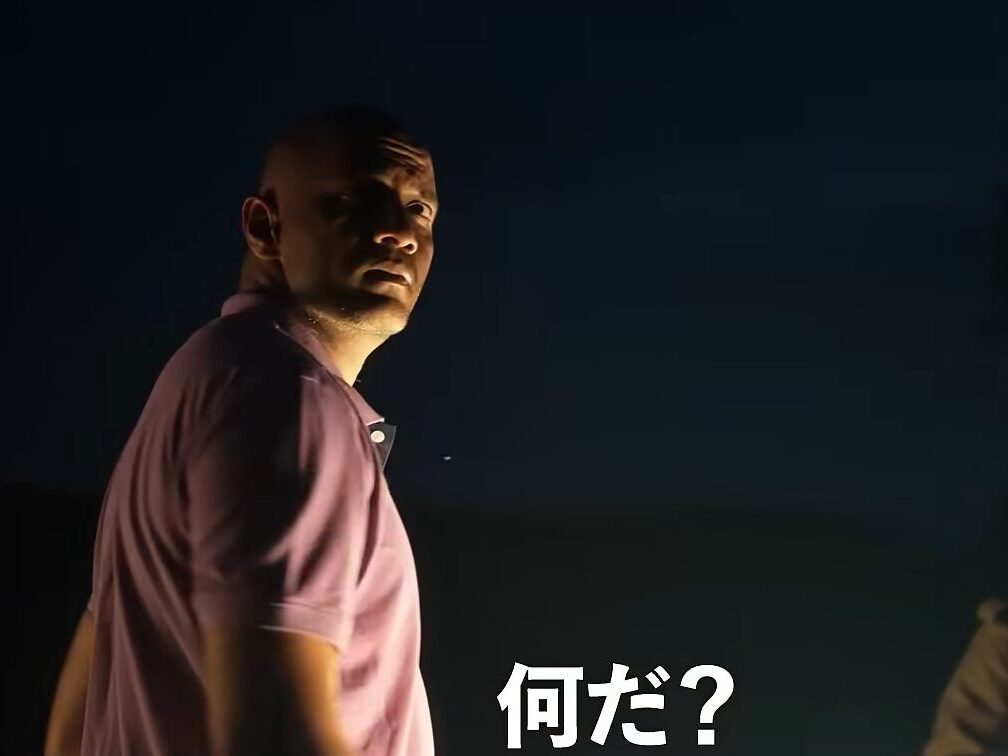
Here’s a fun detail Japanese audiences will love: one specific sequence — Shiva alone in a pitch-black forest at night, startled by that eerie “sharin… sharin…” sound before the deity erupts behind him with a roar — racked up over 6 million views overseas. Reactions ranged from “I literally jumped out of my seat” to “terrifying but hilarious” to “this is the moment the god tries to communicate.” It’s pure, primal cinema, and it’s a big part of why this film travels so well across cultures.
Mubi-Ticket Campaign: The God on Your Smartphone
To celebrate the June 5 premiere, a special Mubi-ticket (前売り券 / advance ticket) campaign is live now.
- Format: Mubi-ticket Online (with special wallpaper bonus)
- Price: 1,600 yen (tax included)
- Bonus: An exclusive “God Descends to Your Smartphone” Panjurli deity wallpaper
- Where to buy: Movie Walker’s official ticket page (ticket.moviewalker.jp)
The wallpaper bonus is a clever touch — a small piece of the film’s divine energy you can carry with you until opening day. Sales started April 17, so if you want both the discount and the collectible, it’s worth grabbing early.
The Story: A Forest Where a Wild God Dwells
About 170 years ago, by the decree of the deity Panjurli, a vast forest was granted to the indigenous people of Kadubettu village. Generation after generation, the villagers performed the Bhoota Kola ritual to honor the god, and even when a greedy landlord tried to reclaim the land, divine protection kept the peace.
But the modern world changes everything. A newly assigned forest officer, Murali (Kishore Kumar G.), sets out to absorb the villagers’ “unauthorized” land into a state-designated protected reserve, throwing the village’s survival into question.
Caught in the middle is Shiva (Rishab Shetty) — the village’s notorious troublemaker and undisputed king of buffalo racing, whose own father was once a Bhoota Kola performer who vanished. As Shiva clashes with the arrogant Forest Department, the land dispute spirals into something no human authority can control — a reckoning that draws in the gods themselves.
And then there’s that climax. Critics and audiences worldwide have called the final stretch genuinely unforgettable — Variety described the film as “searing” — and even an early Japanese test-screening reviewer summed it up in three words: “This is insane.” (In the best possible way.)
The One-Man Powerhouse: Rishab Shetty
Part of Kantara’s legend is the man behind it. Before cinema, Rishab Shetty juggled jobs selling drinking water and working in real estate, dreaming of a way in. He didn’t just break into the industry — he wrote, directed, and starred in Kantara, carrying the entire film on his shoulders, from the athletic intensity of the buffalo-racing scenes to a transcendent, near-otherworldly performance in the climax.
He also made a deliberate choice that helped the film conquer international markets. Where most Indian films run well past three hours, Kantara clocks in at a lean 148 minutes (about 2.5 hours).
“I made an international version with a deliberately shorter runtime,” Shetty explained. “Indian films usually run over three hours with songs, dance, comedy, and subplots. But for Kantara, I wanted to leave audiences with the strength of the story itself. I wanted the rhythm to feel immersive yet tight — moving like a heartbeat, with tension building steadily toward the climax.”
For the Japanese release, Shetty sent a heartfelt message:
“Japan is a country with deep respect for culture, nature, and spirituality — all of which are woven deeply into this film, so I believe you’ll connect strongly with its emotion and its soul. This isn’t just a movie; it’s a cinematic experience, made for the big screen. The sound, the visuals, the energy of the ‘ritual’ — there’s no better place to feel them than in a theater. If you love powerful stories and visceral action, please watch this on the big screen. Don’t miss it! Come experience the roar of Kantara on the big screen in Japan!”
Understanding Bhoota Kola: The Real Tradition Behind the Magic
Here’s what elevates Kantara above a standard action film — and what makes it especially resonant for Japanese audiences with their own deep traditions of nature worship and spirit reverence.
Bhoota Kola (also called Daiva Nema) is not a cinematic invention. It’s a living, centuries-old ritual still practiced today in Tulu Nadu, the Tulu-speaking coastal region of Karnataka. On ritual nights, a hereditary medium dons elaborate makeup, anklets, weapons, and a towering headdress (mudi) crowned by a radiant halo (ani). As drums and pipes intensify, the community believes a guardian spirit — a Daiva — descends into the performer’s body. From that moment, the words spoken are understood to be the god’s.
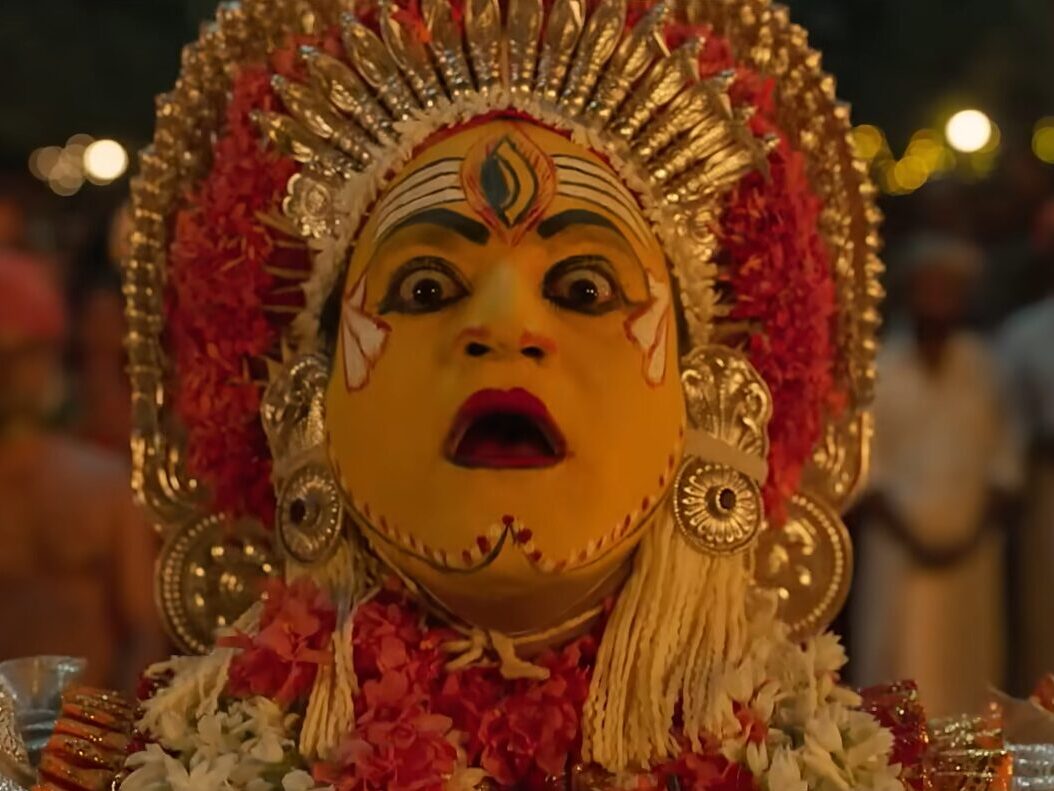
The two guardians at the heart of the film:
- Panjurli — a beloved boar-guardian deity who protects fields, forests, and boundaries. He favors honesty and punishes deceit.
- Guliga — the fierce keeper of oaths and boundaries, who enforces justice when promises are broken and power is abused.
Together they embody a single ethic with cosmic weight: land is a sacred trust, and truth is binding. The ritual itself functions almost as a folk court of justice — villagers bring disputes, oaths are taken in the deity’s presence, and the spirit delivers counsel.
It’s an ecological and moral philosophy disguised as folklore — and it’s the reason Kantara feels less like a story you watch and more like a covenant you witness.
A respectful note: Following the prequel’s success, the filmmakers have asked fans not to casually imitate the Bhoota Kola “spirit avatar,” out of respect for a sacred tradition that is central to Tulu communities. Worth keeping in mind as the fandom grows in Japan.
Why Kantara Resonates Worldwide — and Especially in Japan
Kantara works because it refuses to be just one thing. It’s a folk legend, a conspiracy thriller, and a jaw-dropping action film braided together. Its themes — living in balance with nature, defending ancestral rights, and the idea of divine justice — don’t require subtitles to feel.
For Japanese viewers in particular, the film’s reverence for the unseen, for sacred forests, and for the thin veil between the human and divine world should land with uncommon force. This is mythology with muscle, spirituality with a pulse.
Film Details at a Glance
| Japanese Title | カーンターラ 神の降臨 |
| Original Title | Kantara (KANTARA: A Legend) |
| Year | 2022 |
| Country | India |
| Language | Kannada |
| Runtime | 148 minutes |
| Rating (Japan) | PG12 |
| Director / Writer / Lead | Rishab Shetty |
| Cast | Rishab Shetty, Kishore Kumar G., Achyuth Kumar, Sapthami Gowda, and others |
| Music | B. Ajaneesh Loknath |
| Cinematography | Arvind S. Kashyap |
| Production | Hombale Films |
| Distributor (Japan) | Twin |
| Japan Release | Friday, June 5, 2026 — Shinjuku Piccadilly & nationwide |
| Mubi-Ticket | 1,600 yen (incl. tax) + exclusive Panjurli wallpaper |
Don’t Miss the Roar
Mark June 5, 2026 on your calendar. Lock in your Mubi-ticket, set that Panjurli wallpaper as your lock screen, and prepare for the kind of theatrical experience that doesn’t come around often — one where the screen seems to breathe, the sound rattles your chest, and the final ten minutes leave you genuinely speechless.
The film poses a single question: Will the roar bring salvation, or destruction?
The only way to find out is to be in the theater when the god descends.
Stay tuned for theater listings, additional scene reveals, and promotional updates ahead of the premiere. Excited for Kantara in Japan? Share this with a fellow cinema lover.
#KantaraJapan #カーンターラ神の降臨 #KantaraRelease #BhootaKola #IndianCinemaInJapan #RishabShetty #PanjurliDeity